

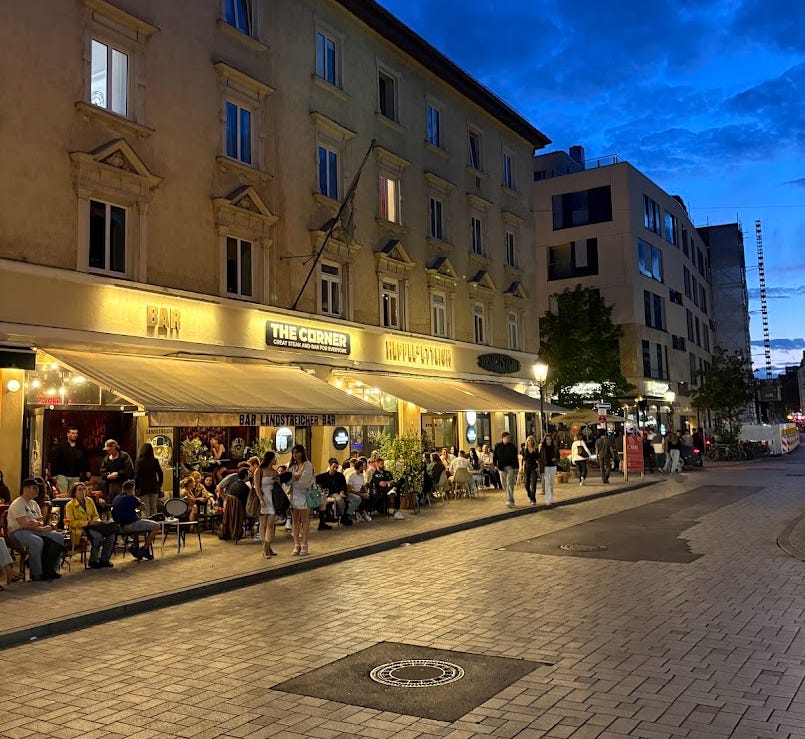
There is a very reasonable argument for leaving the city in your 40s.
You have small children. You need space. A garden would be nice. A spare room would be even nicer. The apartment feels smaller every year, not because it shrinks, but because children expand into every corner of it. Shoes by the door. Toys under the sofa. Tiny jackets on hooks.
All of this is happening in Munich, which is lovely and walkable and easy to live in - and also expensive in a way that becomes harder to ignore once you need more space.
And what are you really using the city for anymore?
You are not out at bars three nights a week. You do not decide at 10 p.m. to meet friends across town. You are not floating from drinks to late dinner to somebody’s birthday that starts when you would now prefer to be asleep.
Your friends are in the same situation. You like each other. You keep saying you should meet more often. But most social life now happens in fragments: a child’s birthday party, a barbecue planned six weeks ahead, the occasional dinner where everyone looks slightly stunned to be out after dark.
If you are an expat, or just moved across the country it narrows further. There is no grandmother around the corner who can step in for the evening. No aunt who casually takes the kids on a Saturday. A spontaneous night out with your wife becomes a logistical operation: timing, bedtime instructions, calculated return. So instead you become good at lunch dates. A weekday hour together. Somewhere near the office or daycare. Coffee if there is time. Back to life.
At this stage, the city can start to look like an expensive backdrop to a life you no longer fully participate in.
And yet.
On a warm day, with nothing urgent pulling me home, I still love getting on my bike and heading toward the centre.
Not always with a plan. That is important. A plan would make it an errand. I just go.
I pass through streets I know well, then into parts of the city that feel like they belong to a slightly different species of person. Students on cheap bikes. People sitting on walls with takeaway coffee. Young couples moving slowly because nobody is measuring the minutes. Groups spilling out of cafés. Someone lying in a park on a Tuesday afternoon, as if the entire economy can wait.
Passing the student quarter in your 40s is its own complicated feeling. They look so free. Probably not as free as they imagine. But full of unallocated time. Time they can waste without noticing. Time to sit somewhere longer than necessary, wander into a shop, change plans, go for one drink and turn it into five.
When you have small kids, time stops feeling like a wide open field. It becomes a set of narrow windows. Daycare pickup. Nap schedule. Dinner. Bath. Someone needs socks. Someone is crying because the banana broke in half. You can have a free afternoon, technically, but somewhere in the back of your mind there is still a timer running.
So why ride toward all that youthful looseness? Why look at a life you no longer have?
Because it reminds me that life is larger than my current routines.
That sounds obvious. It is not obvious when you are inside those routines.
Family life is beautiful, but it is also intensely repetitive. The same kitchen table. The same playgrounds. The same route to daycare. The same evening negotiation over pajamas. Work has its own loops: calls, projects, Slack, responsibilities. Days can become full without feeling wide.
The city widens them again. Not through anything dramatic. Through contact. A crowded terrace of people who all decided to be somewhere at the same time. An old man reading a newspaper outside a bakery as if this is the only correct way to spend a morning. A student in an outfit that would look absurd anywhere else but somehow works here. A protest you did not know was happening. A new restaurant in a street you have crossed a hundred times.
None of this is for me, exactly. That may be part of the appeal.
In your 40s with children, so much of life is personally addressed to you. Your inbox. Your calendar. Your kids calling from the other room. Your obligations. Your domestic backlog. The city is indifferent. It does not ask anything of you. It is just happening.
I do not need to enter every room the city offers. I do not need to attend every concert, try every restaurant, stay out late, know the new spots. I like knowing they exist. I like being near them. I like the possibility, even if I rarely use it.
People sometimes dismiss that as paying for access you do not take advantage of. Maybe. But we do this in other parts of life without embarrassment. We live near nature because we like knowing the forest is there, even if we do not hike every day. We want a balcony even if half the year it is too cold to sit outside.
It changes the atmosphere of ordinary days. A Saturday with children can become not just “what playground again?” but a tram ride to a market, a walk through a busy square, ice cream near a museum you may or may not enter. A lunch break can become twenty minutes along a street with life in it, rather than another sandwich at the desk. A bike ride home can pass through a neighbourhood where you momentarily feel connected to the larger human mess.
The older I get, the more I think this matters.
Not because cities keep you young. That phrase is too neat. Cities can also exhaust you, drain your money, sharpen your sense that other people are doing more interesting things. But they can keep you from prematurely shrinking your world.
There is a version of middle age that becomes entirely optimised around convenience: a bigger house, easier parking, quieter streets. Sensible. And maybe that is exactly right for some people. I understand the pull. I feel it myself.
But I worry about over-optimising life around the needs of the current decade.
Small children are a phase, even when they feel like a permanent climate. The need for help, routine, nearby schools, predictable evenings - all of that is real. But it is not the whole story of who you are. You are still a person who may want to hear music from an open window, sit among strangers, catch the edge of an idea, pass through a neighbourhood and feel your thoughts loosen.
A city gives you that without requiring commitment.
Sometimes all I do is bike in, wander for a bit, drink a coffee, and come back. Nothing happens. But I come back different from how I left.
That, for me, is the strongest case for staying in a city in your 40s. It is not really about nightlife, or status, or even convenience, though convenience matters too. It is the quiet reassurance that beyond the walls of your apartment, beyond your own recurring tasks, life is still moving in every direction. Young people are wasting afternoons. Someone is starting a business that will fail. Someone is sitting alone in a café, watching all of it.
And you can ride your bike through the middle of it, then go home to bedtime.